DistAL: Distance-based Advantage Learning for VLA Fine-Tuning
Reece O'Mahoney, Ioannis Havoutis
Oxford Robotics Institute, University of Oxford
Overview
Vision-language-action models (VLAs) have transformed the field of robotic manipulation in recent years by combining the semantic understanding of LLMs with the precise control of flow-matching policies. Advantage conditioning is a recent technique that iteratively improves VLAs by training a value function on deployment data and using this to train an advantage-conditioned policy. Previous works have only applied simple, low-information success/failure rewards, which leave the value function unable to distinguish states of differing quality beyond how far along the task they appear. Motivated by an exploration of out-of-distribution (OOD) detection methods, we introduce Distance-based Advantage Learning (DistAL), which, by using an embedding space distance as a reward, produces a more informative value function and subsequently a higher downstream task success rate. We validate our method on a series of simulation benchmarks and dexterous bi-manual manipulation tasks on real hardware.
Method
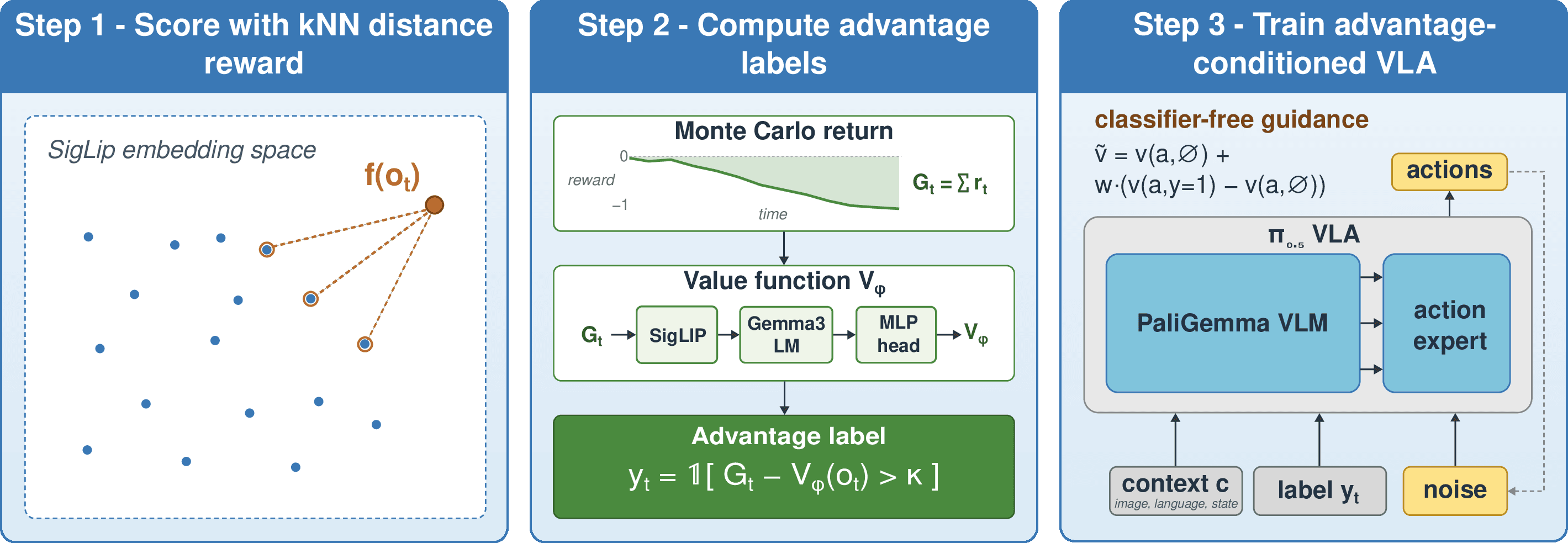
The advantage-conditioning pipeline that DistAL builds on trains a value function on deployment trajectories annotated with per-timestep rewards, computes the advantage at each timestep, thresholds it into a binary positive/negative label, and fine-tunes the VLA on that label using classifier-free guidance. So far this pipeline has only been paired with a binary success/failure reward with a constant per-step penalty, which means the only factor that raises a state's value is the estimated number of steps remaining. An unstable grasp that barely holds an object and a secure one receive the same value despite very different odds of eventual success. DistAL is a drop-in replacement for that reward signal, with the policy, value function and training procedure left unchanged, isolating reward design as the single variable.
kNN feature-distance reward. DistAL is motivated by the idea that failure trajectories will be out-of-distribution when compared to a reference dataset of successes. We build an index of embeddings over all observations in the dataset used to train the base VLA, using the same fine-tuned SigLIP vision encoder as the base VLA. For any observation encountered at deployment, its score is the mean distance in embedding space to its k nearest neighbours in that index, and the per-timestep reward is the negative of this distance. Because a policy could in principle raise this reward by remaining in familiar states rather than progressing, we retain the large terminal penalty on failed episodes from prior work. The dense distance supplies a per-step signal of how far the policy has drifted from the training distribution, while the failure penalty preserves a strong signal of eventual task success.
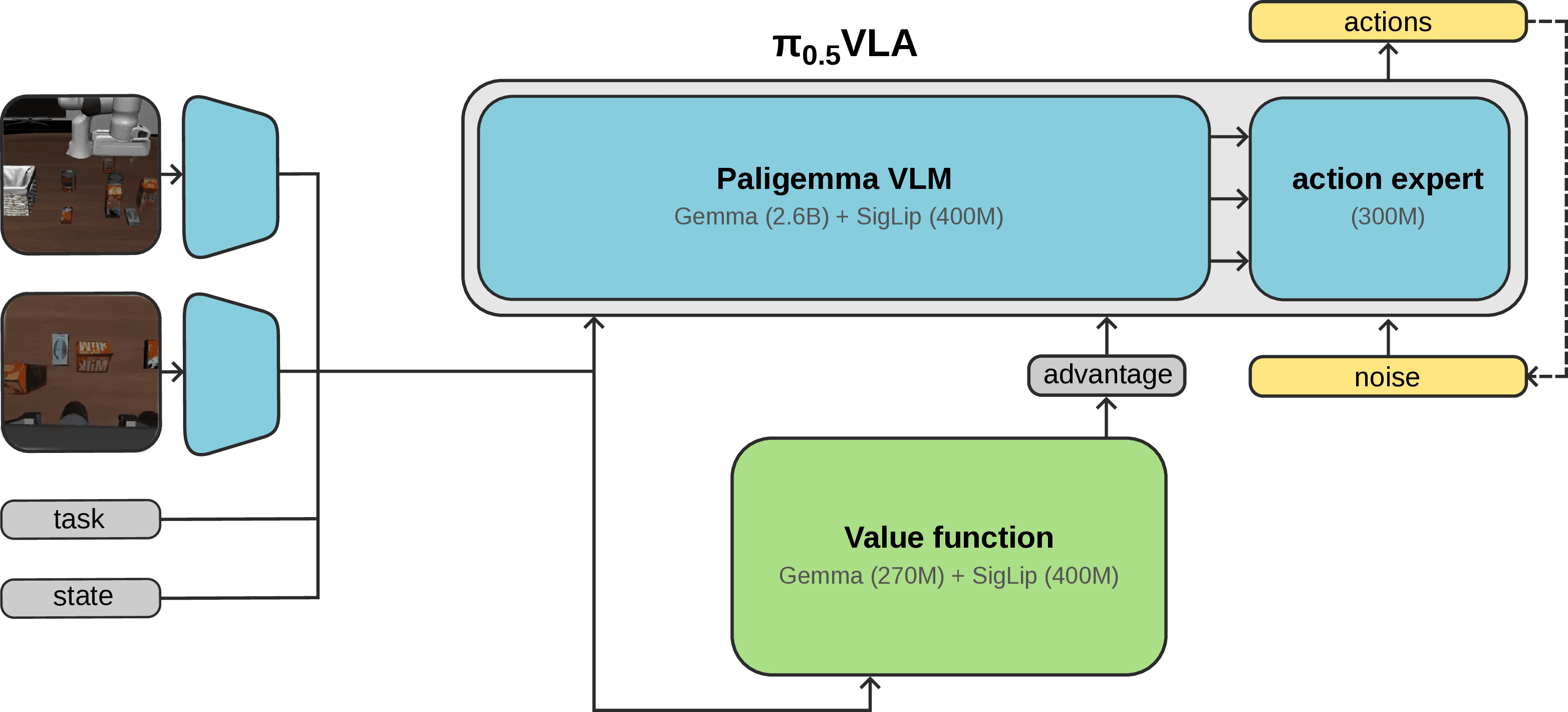
Architecture and training. The value function consists of a pre-trained Gemma3 270M language model and a 400M SigLIP vision encoder, receiving the same image, language and state conditioning that the policy observes, with a small MLP head predicting a categorical distribution over discretised return bins. It is fit by Monte Carlo regression onto the full-episode return. The policy is a fine-tuned π0.5 model. The binary advantage label is injected by appending the text “Advantage: positive” or “Advantage: negative” to the tokenised language input, with the threshold set so that 30% of labels are positive. Training proceeds in three steps: score every deployment observation with the kNN distance, fit the value function and label each timestep by its advantage, then fine-tune the VLA on the label, dropping it to a null token with some probability so that classifier-free guidance can be applied at inference.
Results
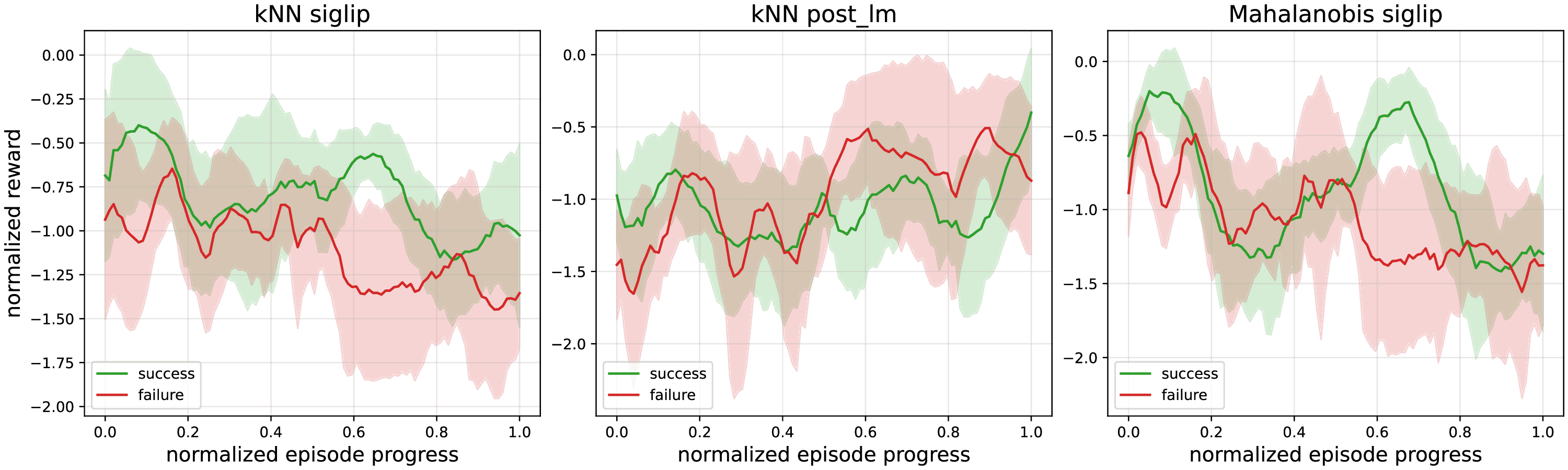
OOD detection as a failure predictor. We first ask which metric best predicts task success, collecting rollouts from the base π0.5 policy on LIBERO, LIBERO-plus and two bi-manual hardware tasks, and reporting AUROC at both the per-trajectory and per-timestep level. The kNN distance on SigLIP features is the strongest detector on both measures (0.82 per-trajectory and 0.67 per-timestep mean), ahead of a VAE likelihood (0.79 and 0.65), Mahalanobis distance in the same feature space (0.71), kNN on the language model's image tokens (0.57) and action-chunk variance (0.58). The gap between successful and failed rollouts opens progressively through the episode rather than only at the terminal frame.
Simulation. We evaluate on LIBERO-10 and LIBERO-plus against the base π0.5, SFT on success-filtered deployment data, and a RECAP-style binary reward with the identical pipeline. DistAL is the strongest method on every aggregate, with the best LIBERO-10 score (96.2%) and highest overall mean (78.4%, +3.3 over base). The largest gains are on the perturbations the base handles worst: Camera (+25.2 over base), Noise (+14.1) and Texture (+10.7, reaching 100%). Against the binary-reward baseline, DistAL wins on 5 of the 8 columns, with its largest individual gains on Camera (+4.8) and Texture (+7.7).
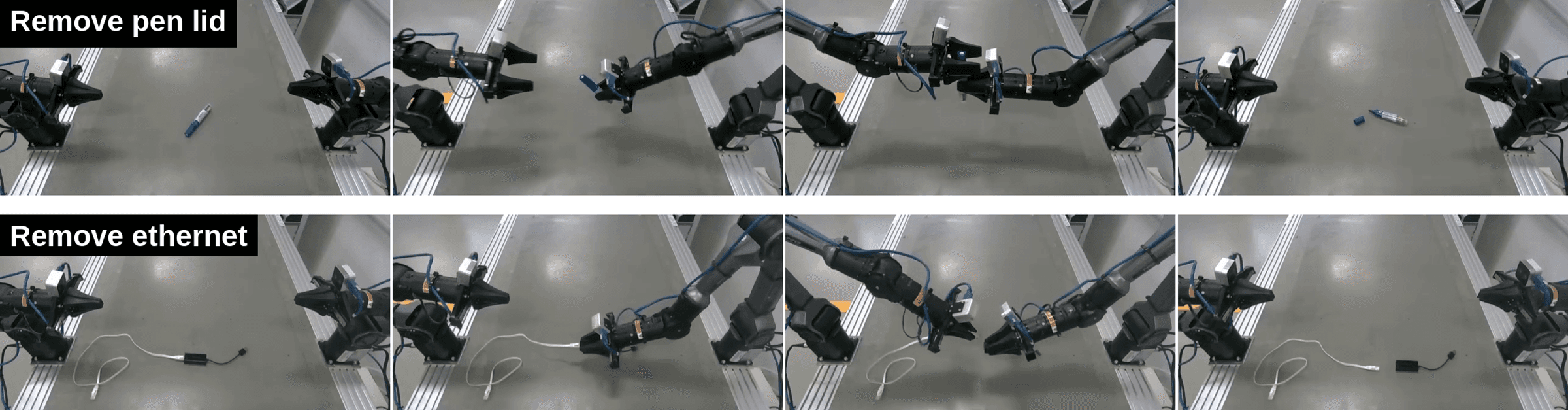
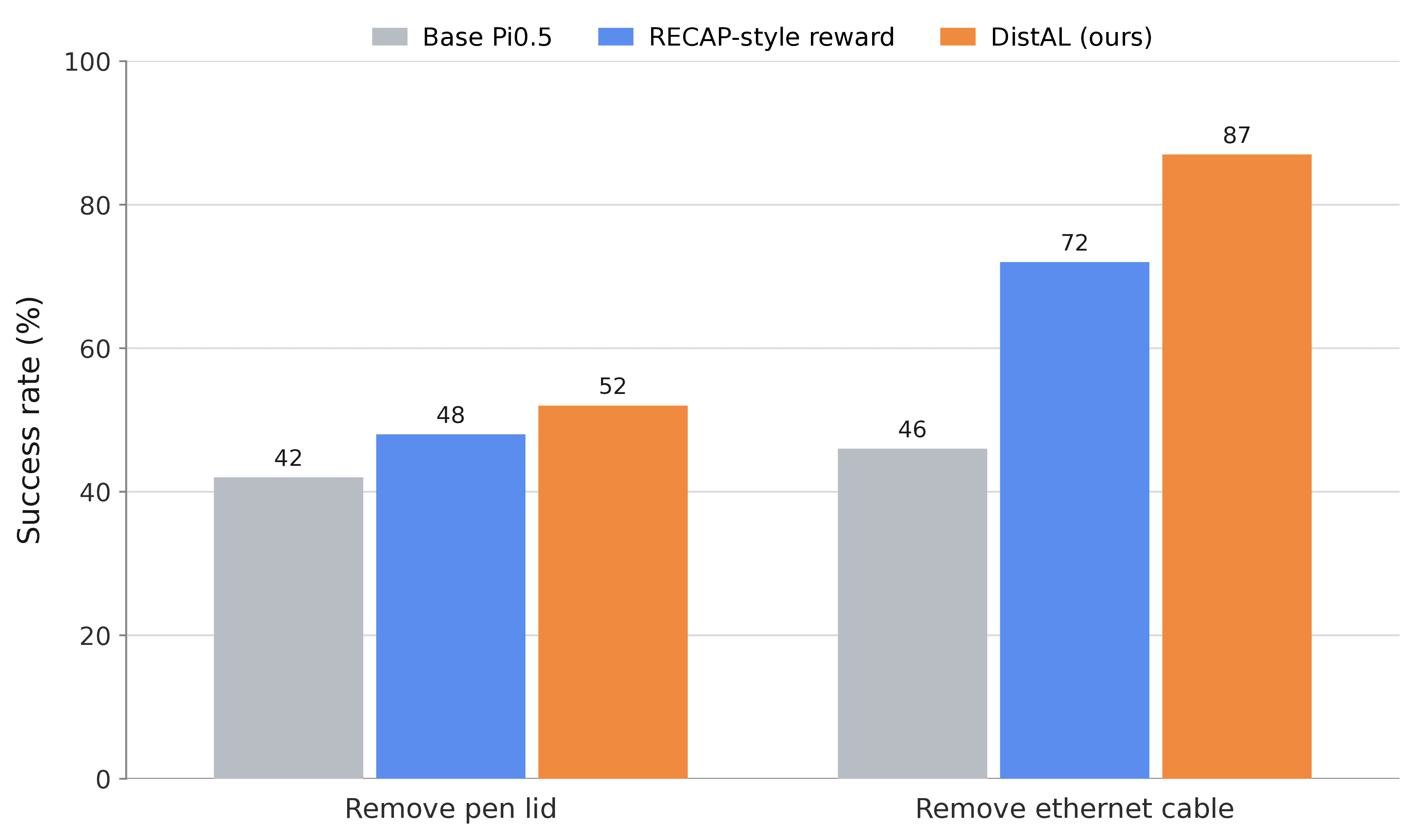
Hardware. We use a bi-manual setup of two Piper arms on two contact-rich tasks: remove pen lid and remove ethernet cable. On the ethernet task, DistAL reaches 87% against 46% for the base policy and 72% for the binary reward. On the pen lid task DistAL is again best at 52%, a 10-point gain over base but only 4 points above the binary reward. This split matches the failure-prediction results: ethernet failures are visually obvious, while pen-lid failures are a correctly formed grasp that slips under load, which the image does not show. DistAL is therefore most useful when a task's failure modes are visually distinguishable from its success modes.
In summary, DistAL replaces the sparse success/failure reward in advantage-conditioned VLA fine-tuning with a dense per-step reward based on the k-nearest-neighbours distance to the base VLA's training distribution, keeping the rest of the pipeline fixed. This distance is the strongest predictor of failure among a range of OOD detection baselines, and the resulting policy improves over the base π0.5 on LIBERO-10, LIBERO-plus and two bi-manual tasks on real hardware, and over the binary-reward baseline where failure is visually separable from success.