DetAug: Obstacle-Blind Trajectory Augmentation for Zero-shot Obstacle Avoidance
Reece O'Mahoney1, Moritz Zoellner2, Ioannis Havoutis1
1Oxford Robotics Institute, University of Oxford
2Purdue University
Overview
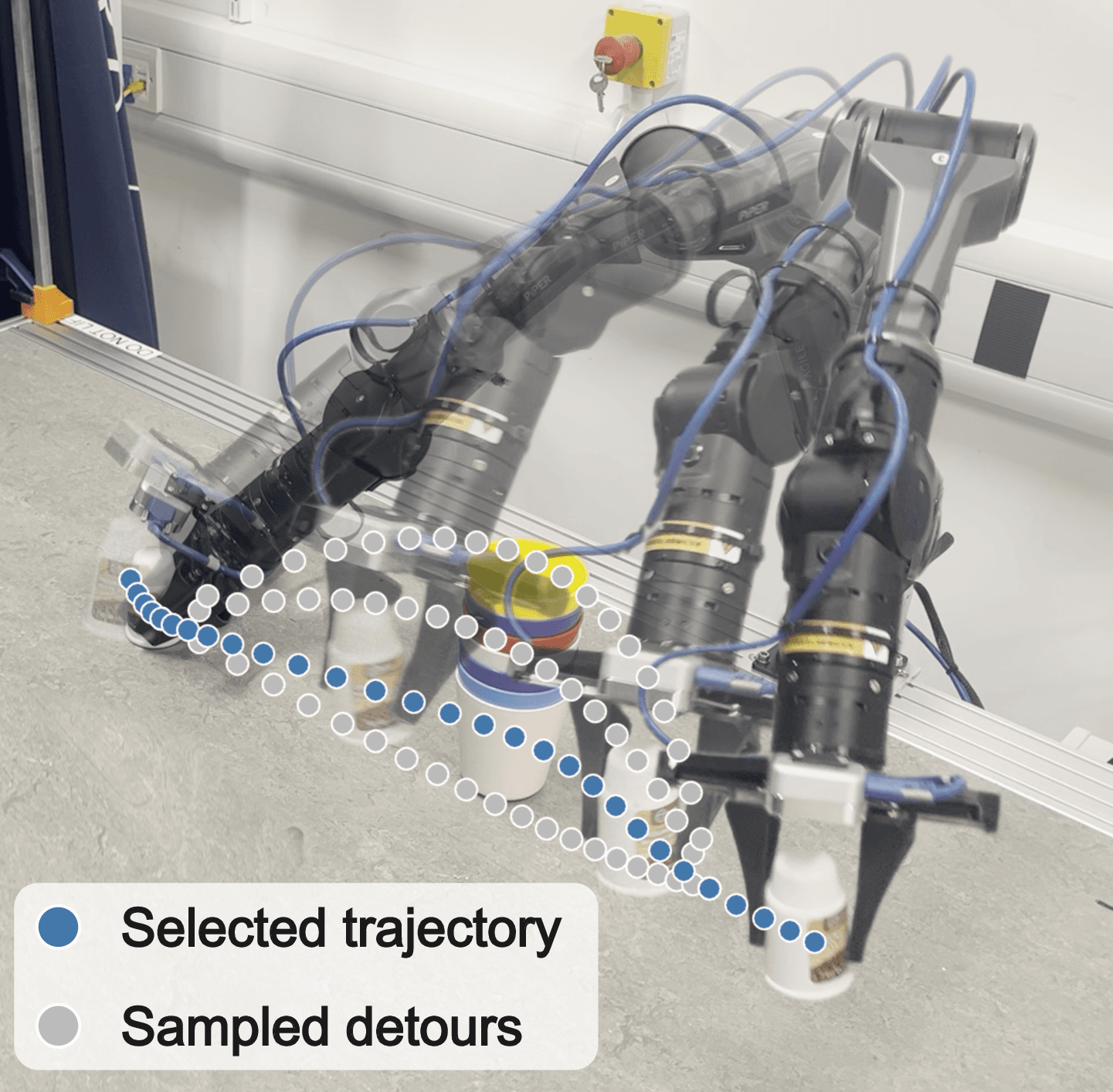
Policies for robotic manipulation are produced by training on large teleoperated datasets. These datasets typically consist of free-space trajectories, making them difficult to transfer to test-time environments with obstacles. Previous methods for closing this gap have largely fallen into two groups. Dataset augmentation addresses it at training time but needs obstacle geometry in advance, whereas steering an existing checkpoint at inference time avoids that requirement but is limited in flexibility. Our method draws from both areas without inheriting either drawback. DetAug applies an obstacle-blind augmentation scheme to the transit phases of a free-space dataset, leaving object interactions untouched, and records the augmentation parameters as an explicit conditioning label. At inference it samples a batch of labels and executes the trajectory with the lowest collision cost. On the SafeLIBERO benchmark DetAug achieves a collision-free success rate more than 20pp above the next best method, and selecting over the label space outperforms guidance on the same policy by 26pp. On real hardware, inference-time steering methods collapse on tasks requiring large detours, while DetAug matches or exceeds an obstacle-conditioned baseline without ever seeing obstacles in training.
Method
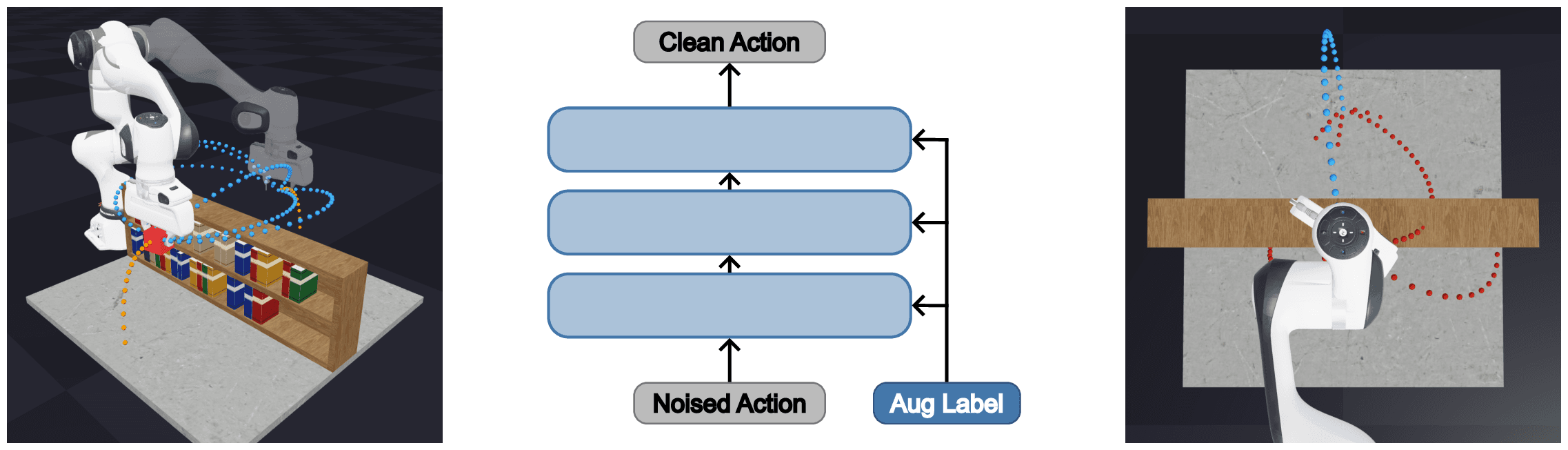
DetAug (Detour Augmentation) starts from a dataset of free-space teleoperated demonstrations and augments them with randomly generated arcs, recording the augmentation parameters as a conditioning variable. A flow-matching policy is then trained to recreate these trajectories, with the augmentation label injected into the model via AdaLN-Zero. At inference, the policy samples a batch of plans with different randomly sampled labels from the training support, scores them with an analytic collision cost, and executes the best trajectory. Steering methods assume the required modes already exist in the prior, and augmentation methods assume the obstacles are known. DetAug assumes neither.
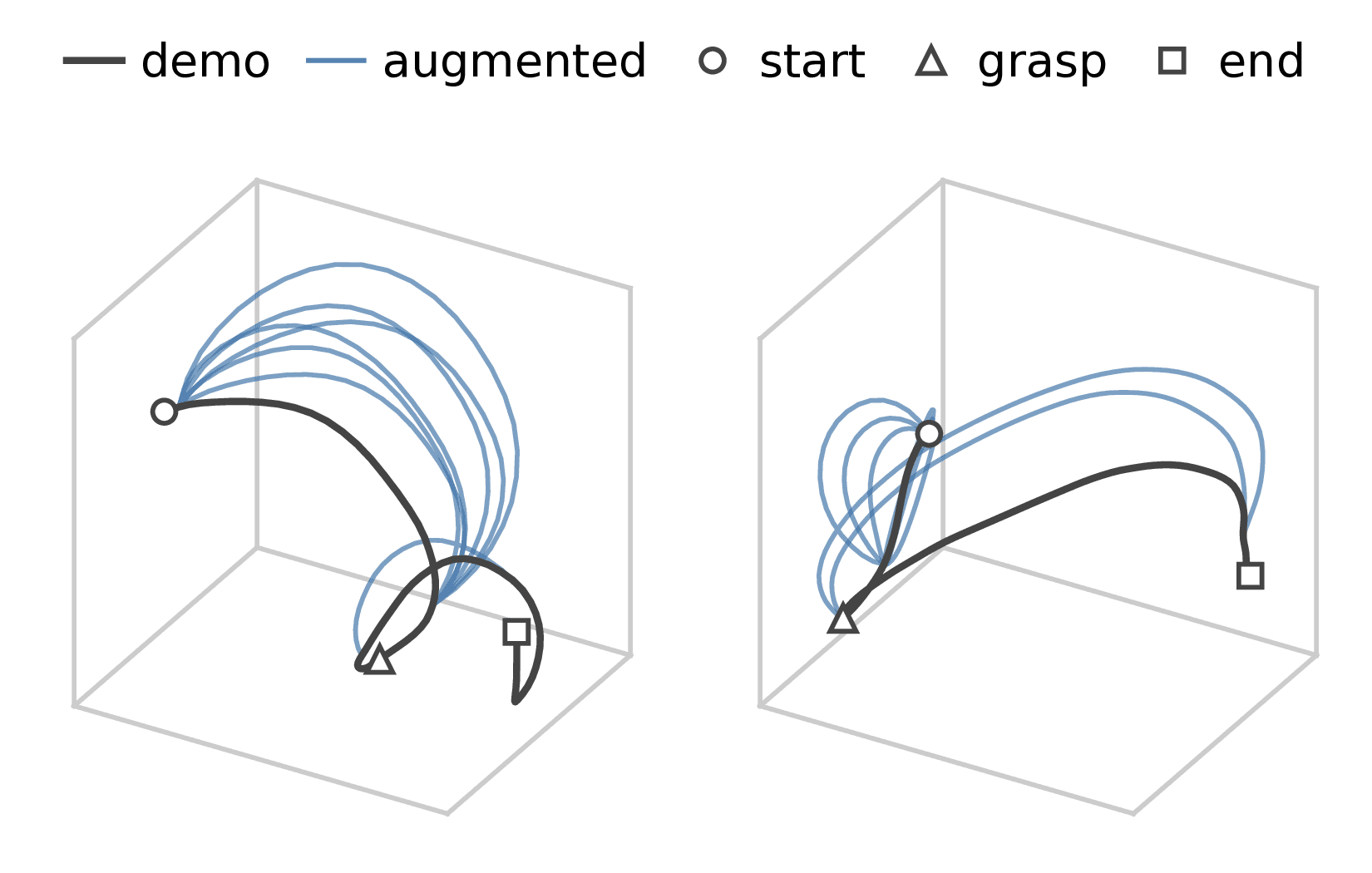
Detour augmentation. Demonstrations are first split into interaction and transit phases. Interaction phases are a fixed window around each gripper transition, and transit phases are the motion between them: an approach from the start to the grasp, and a carry from the grasp to the release. Each transit phase, minus a margin on either side, is replaced with a circular arc of a sampled half-angle φ, lying in a plane rotated by a sampled angle θ about the original chord. The label for an arc is its half-angle expressed as a 2D vector in the direction of the plane rotation, so a grasp carries a 4-dimensional label. This gives a smooth, continuous parameterisation that is zero for unbent demos. Samples are checked for kinematic feasibility and joint motion smoothness, and any that fail are rejected. Only the transit phases are modified; the grasp and release windows are preserved exactly, so avoidance can never corrupt an object interaction.
Architecture. The policy is a DiT-style transformer trained with a conditional flow matching loss. It outputs a chunk of states and actions and replans every few action steps, like a standard action chunking model. The conditioning vector is the sum of an embedding of the flow-matching time and an embedding of the augmentation label, and is injected through AdaLN-Zero conditioning. This also makes it easy to graft the augmentation label onto an existing pre-trained policy.
Inference-time selection. At inference a batch of K labels is sampled uniformly from within the training support, and a trajectory is generated for each, conditioned on the current observation. This is repeated with a fresh batch at every replan rather than latching the first choice, since an early pick made under a partial view of the scene is rarely the best one later. Trajectories are scored with a collision cost computed from points sampled along the robot's surface against a signed distance field of the obstacle. Trajectories are scored by penetration only rather than clearance, as clearance tended to produce overly circuitous paths that hurt task success. Geometry is used only to rank candidates, never to construct trajectories.
Results
SafeLIBERO benchmark. We evaluate on the simulated SafeLIBERO benchmark, where the training data is the standard LIBERO scenes but random obstacles are inserted at test time. Baselines are DemoGen (a train-time method with access to the obstacle geometries during training), AEGIS (a purely inference-time CBF-QP applied to a frozen policy's output) and CAPE (an inference-time method applying collision guidance to a re-noised copy of the unexecuted plan). DetAug achieves a 52.2% collision-free success rate averaged over the four suites, more than 20pp above the next best method (CAPE at 30.6%), and the best total success rate of 67.6%. The inference-time methods have high avoidance rates but low success, often ending in timeouts as the policy is unable to find a feasible path. DemoGen, despite having obstacle geometry, is conditioned on a single point cloud embedding that proves too weak a signal to push trajectories along significantly different paths.
| Method | Clean | Total | Avoid |
|---|---|---|---|
| DetAug (ours) | 52.2 | 67.6 | 65.4 |
| DemoGen | 20.3 | 54.9 | 26.3 |
| CAPE | 30.6 | 36.0 | 74.7 |
| AEGIS | 26.6 | 35.9 | 64.2 |
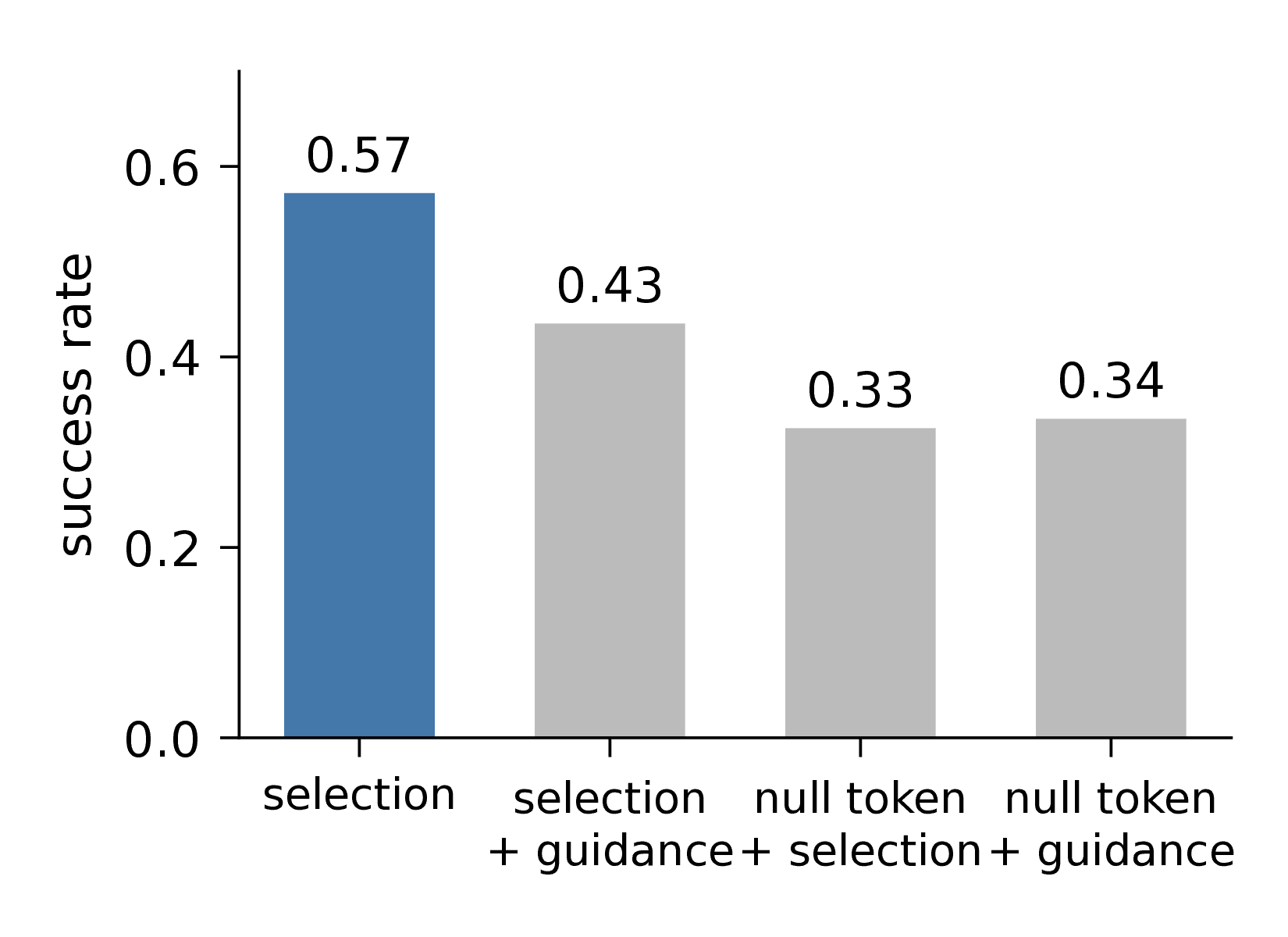
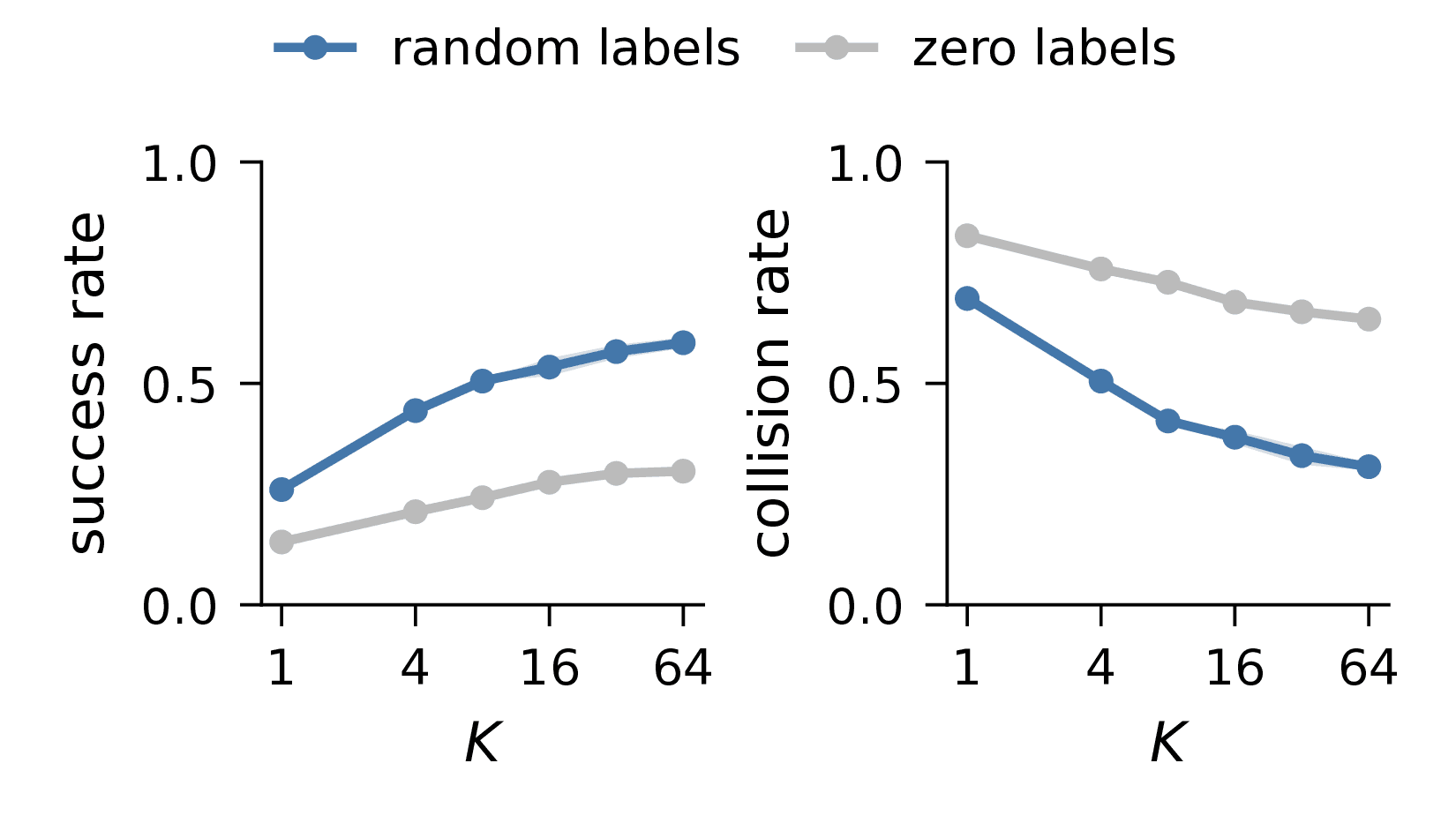
Selection vs guidance. To compare selection over the label space against guidance, we train the policy with the label randomly dropped out for a null token so that the same collision cost can be used as a guidance gradient. Guidance on the null token performs 26pp worse than label selection, and mixed variants also perform worse. We hypothesise that the 4-dimensional label reduces the search space compared with the full state and action space, and that the label parameterises the clean sample whereas guidance acts on off-manifold noisy intermediates. Increasing the number of sampled labels K raises success monotonically, and random labels beat zero-valued (unaugmented) labels at every batch size.
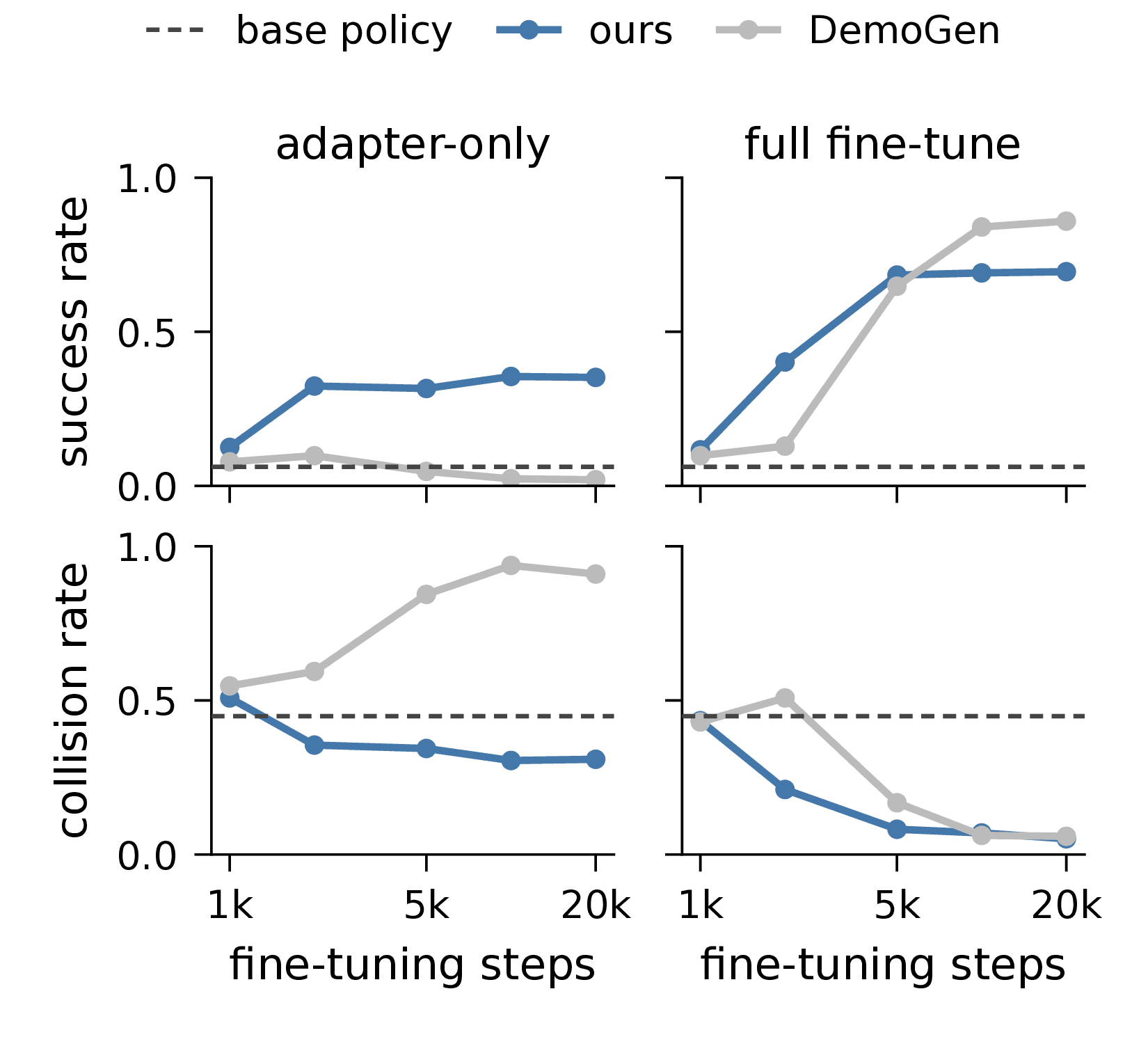
Adapting a pre-trained policy. To add obstacle avoidance to an existing policy, we adapt a base policy trained on the unaugmented dataset via AdaLN, injecting either the augmentation label (DetAug) or a point cloud embedding (DemoGen). With a frozen backbone and a 3M parameter adapter, DetAug reaches 35% success versus 2% for DemoGen, which is worse than the base policy's 6%. With full fine-tuning DemoGen is able to beat DetAug in success rate, albeit with a greater number of training steps.
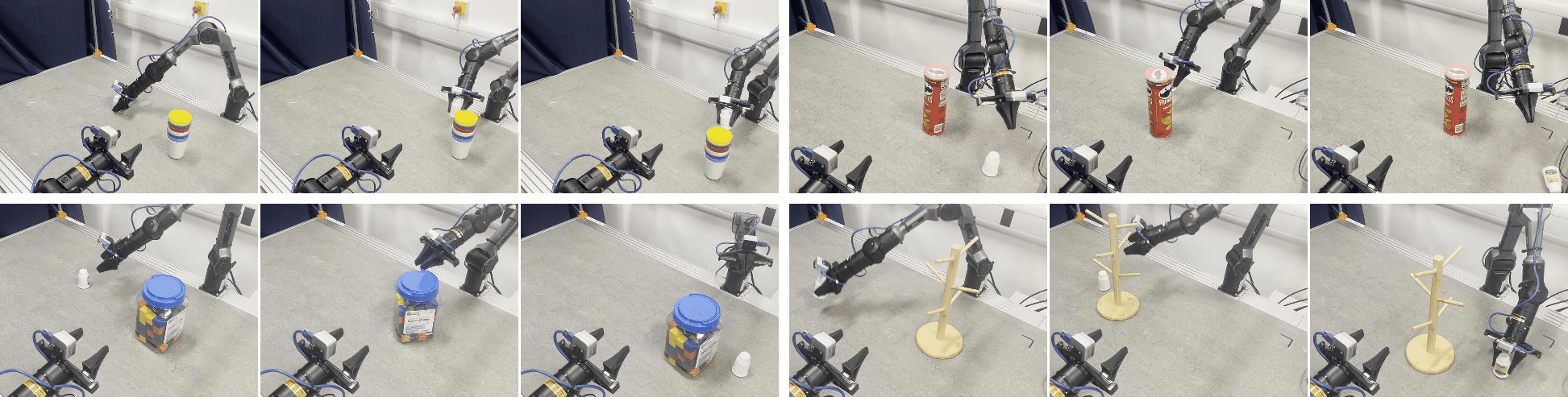
Hardware. We train a policy on a pick-and-place task from free-space demonstrations, then roll out each method with four obstacles of different shapes placed at random positions, 10 rollouts per obstacle type. DetAug is the best performing method at 87.5% average success, with DemoGen second at 80%; DemoGen's failures mainly came from moving straight through the obstacle where large detours were required. The inference-time methods collapse to 35% (CAPE) and 30% (AEGIS). They struggle with significant detours from the prior, and because neither separates grasping from transit, their corrections interfere with the object interaction, an issue DetAug avoids by construction.
In summary, DetAug adapts manipulation policies with zero-shot obstacle avoidance without any knowledge of the test-time environment during training. It significantly outperforms prior methods on a broad suite of simulation tasks, selection over the augmentation label outperforms guidance on the same policy, and on real hardware it matches or exceeds an obstacle-conditioned baseline that saw obstacles in training. In future work we would like to scale this method to a large VLA model and to tasks requiring greater dexterity.